
✨ This article was AI edited. Editorial responsibility: SabriNasSinlessSecrets.com.
Yes, freezing is universally recognized by professional bakers and food scientists as the best method for preserving gluten-free bread. (German query: Kann man glutenfreies Brot einfrieren? — Ja, absolut!) Because gluten-free baked goods lack the moisture-retaining gluten protein network, they dry out rapidly at room temperature. Proper freezing locks in moisture, maintains crumb elasticity, and prevents starch retrogradation.
Table of Contents
- Why Freezing is Superior to Refrigerator Storage
- Step-by-Step Slicing and Flash-Freezing Protocol
- Comparison Table: Freezing Different Gluten-Free Baked Goods
- Culinary Revitalization Hacks for Defrosted Bread
- Special Handling for Gluten-Free Hamburger Buns and Dinner Rolls
- Chemical Dynamics: Xanthan Gum vs. Psyllium Gel Stability
- Frequently Asked Questions
Why Freezing is Superior to Refrigerator Storage
Many home cooks mistakenly place fresh gluten-free bread in the refrigerator to make it last longer. However, food science proves that refrigeration accelerates bread staling:
- The Starch Retrogradation Zone: Between 32°F and 45°F (0°C–7°C)—the exact temperature range of household refrigerators—amylose and amylopectin starches recrystallize at maximum speed, expelling water and turning bread crumbly within 24 hours.
- Sub-Zero Freshness Locking: In contrast, freezer temperatures at or below 0°F (-18°C) completely halt chemical retrogradation, freezing water molecules instantly in place and preserving bakery freshness for months.
Step-by-Step Slicing and Flash-Freezing Protocol
To ensure individual slices never stick together in an unmanageable block of ice, follow this foolproof kitchen method:
- Complete Cooling: Always allow fresh homemade or bakery bread to cool 100% to ambient temperature (at least 2.5 hours). Freezing warm bread traps condensation, forming ice crystals and soggy crusts.
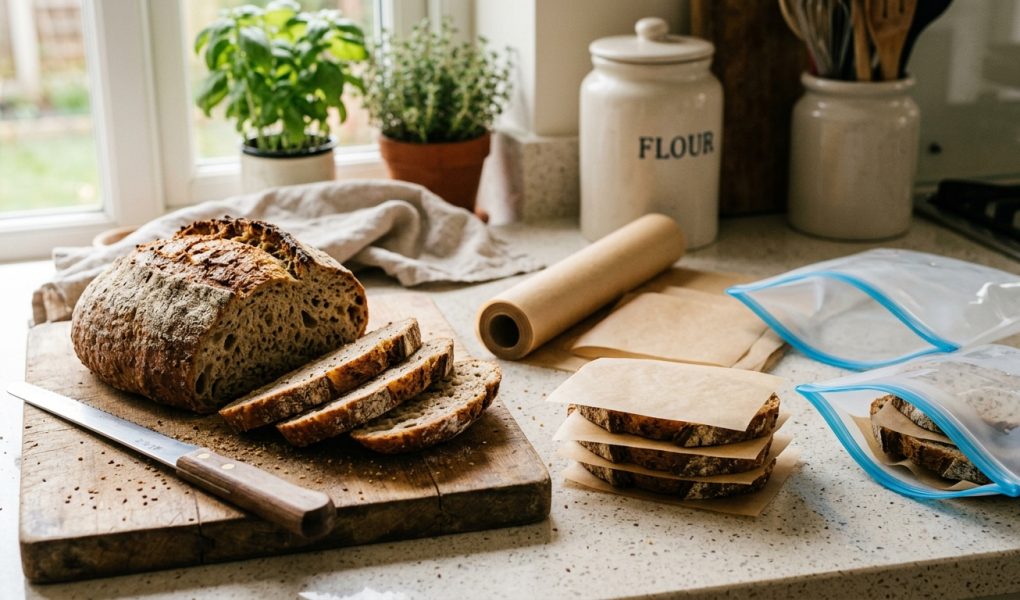
- Pre-Slice with a Serrated Knife: Slice the loaf evenly into 1/2-inch sandwich slices. Slicing a rock-hard frozen loaf is dangerous and crushes the crumb structure.
- The Parchment Separator Method: Cut small squares of non-stick parchment paper and place one between every 1–2 slices. This allows you to pull out a single slice for morning toast effortlessly.
- Airtight Double-Barrier Packaging: Wrap the sliced loaf in plastic food film, then place it inside a heavy-duty freezer zip-top bag. Press out all remaining air before sealing.
Comparison Table: Freezing Different Gluten-Free Baked Goods
| Baked Good Type | Freezer Shelf Life | Best Thawing Technique | Key Preservation Tip |
|---|---|---|---|
| Sandwich Loaves (Rice/Sorghum) | 3 to 4 months | Direct toaster setting 3–4 | Parchment separators between each slice |
| Artisan Sourdough Boules | 4 to 6 months | Oven bake at 350°F (175°C) for 10 min | Mist lightly with water before oven heating |
| Bagels & English Muffins | 3 to 5 months | Direct toaster / bagel cycle | Pre-cut in half completely before freezing |
| Focaccia & Flatbreads | 2 to 3 months | Hot cast iron skillet / oven broil | Drizzle fresh olive oil while reheating |
Culinary Revitalization Hacks for Defrosted Bread
If defrosted bread feels slightly dry, these master tips restore pillowy tenderness in minutes:
- The Steam Toast Trick: Wrap a frozen slice in a barely damp paper towel and microwave on 50% power for 10 seconds before popping it into the toaster. The trapped steam re-hydrates the crumb instantly.
- Skillet Searing with Butter: Melt 1 teaspoon of grass-fed butter in a non-stick skillet and toast the frozen slice over medium heat for 2 minutes per side until golden and fragrant.
- Artisan French Toast: Frozen gluten-free bread absorbs egg custard exceptionally well without disintegrating. Dip frozen slices directly into whisked eggs, cinnamon, and vanilla for breakfast perfection.
- Savory Garlic Herb Croutons: Cut leftover thawed crusts into bite-sized cubes, toss with olive oil, granulated garlic, and sea salt, and bake at 350°F (175°C) for 12 minutes.
Special Handling for Gluten-Free Hamburger Buns and Dinner Rolls
Specialty bread shapes need careful handling to avoid freezer compression:
- Pre-Slice Buns: Always split burger and hotdog buns horizontally before freezing. When ready to eat, toast them directly cut-side down in a hot pan.
- Individual Dinner Rolls: Flash freeze rolls separately on a parchment-lined baking sheet for 1 hour until solid, then transfer to a freezer bag. This prevents rolls from sticking together.
- Tortillas & Wraps: Place wax paper between gluten-free wraps so individual sheets peel away easily without tearing.
- Pizza Dough Crusts: Par-bake gluten-free pizza crusts for 8 minutes, cool completely, and freeze flat between parchment sheets.
Chemical Dynamics: Xanthan Gum vs. Psyllium Gel Stability
Understanding how binders withstand sub-zero temperatures helps you select or bake higher-quality gluten-free loaves:
- Psyllium Husk Fiber: Psyllium creates a resilient matrix that locks bound water within carbohydrate chains during the freezing phase, resulting in zero crumb separation upon thawing.
- Xanthan & Guar Gums: Synthetic or fermented gums maintain elasticity across multiple temperature shifts, preventing loaves from becoming brittle.
- Tapioca Starch: Adds stretch and chew that revives beautifully under radiant oven heat.
Frequently Asked Questions
Can you freeze gluten-free bread with yeast and baking powder?
Yes. Both yeast-raised and chemically leavened (baking powder/soda) gluten-free breads freeze exceptionally well once fully baked and cooled.
How do you prevent freezer burn on gluten-free bread?
Freezer burn occurs when dry freezer air makes contact with the bread surface, causing moisture sublimation. Double wrapping—first in plastic cling wrap and second in a thick zip-top freezer bag—eliminates air pockets and prevents ice crystal formation.
Can you refreeze gluten-free bread?
It is not recommended to refreeze bread after thawing completely, as each freeze-thaw cycle breaks down starch structures, resulting in a gummy, wet texture upon subsequent re-thawing.
Get our latest guides, news, and insights highlighted in your Google Search & AI Overviews.


